5 Voting Site: Check-in Station Procedures
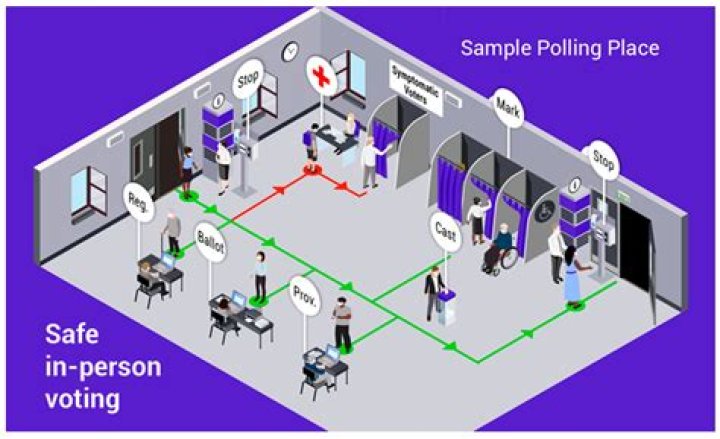
In this section, the “perfect language” for election officials to use when engaging with voters is given. Election officials must use the “best language” to ensure an effective, informative and statutorily sound interaction with voters. In this resource guide, the “best language” is noted in the blue shaded boxes. In the Station Guide, look for pages with the “best language” icon.
Use of the Voting Site Station Guide
A NC Voting Site Station Guide (hereinafter “Station Guide”) must be placed at each Check-in Station. The Station Guide is a training tool, on-demand quick reference tool for the voting site, and a visual aid for voters in the voting site. Using the station guide, election officials will have access to the “best language” to explain election procedures to voters, but voters will be able to see and read for themselves the guidance official are required to give. The purpose of the Station Guide is to:
Provide election officials with immediate access to certain election laws and policy.
Provide quick summary of voting site procedures.
Provide elections officials with clear, consistent, and uniform language to provide to voters.
Provide voters with ability to hear and see clear, consistent, and uniform instruction on voting laws and policy.
And to provide transparency, competency, compliance, and assurance.
The Station Guide must be displayed in a manner that voters approaching the Check-in Station will clearly see that he or she must state their name, address, and if the election is a partisan primary, his or her party affiliation.
The voting procedures are set out in statute and North Carolina Administrative Code. In summary, GS 163-166.7 requires that a person seeking to vote shall enter the voting enclosure and shall state his or her current name, residence address, and during a partisan primary, party affiliation.
These requirements are further provided in N.C. Administrative Code:
08 NCAC 10B .0103 VOTING PROCEDURES (b) A person seeking to vote shall enter the voting enclosure at the voting place through the designated entrance and shall clearly communicate the person's name and place of residence to one of the judges of election. In some cases, the precinct judge may prompt the voter to provide this information. In a primary election, the voter shall also state the political party with which the voter affiliates and in whose primary the voter desires to vote, or if the voter is an unaffiliated voter permitted to vote in the primary of a particular party, the voter shall state the name of the authorizing political party in whose primary the voter wishes to vote. This information, including the political party's primary in which the voter elected to participate, provided by the voter shall be recorded in the precinct pollbook or on the voter authorization slip. The judge or assistant to whom the voter gives this information shall announce the name and residence of the voter so that the information may be heard by the necessary officials and observers. After examining the precinct registration records, the judge or assistant shall state whether the person seeking to vote is registered. The precinct judge or assistant shall not presume the identity/name, address, or party affiliation of any person seeking to vote. (c) If the person is found to be registered and is not challenged, or if the challenge is overruled, the responsible judge of election shall provide the voter with each official ballot the voter is entitled to vote. In a primary election the voter shall be allowed to vote the political party ballot(s) the voter is entitled to vote and no others, except non-partisan ballots. Unaffiliated voters may choose to participate in only one party's primary and no others on the same day. In the case of a second primary, unaffiliated voters who participated in a party's primary in the first primary may only vote that party's ballot in the second primary. However, if an unaffiliated voter did not participate in the first primary, the voter may choose which party's primary to participate in during the second primary. Note that unaffiliated voter participation in party primaries is subject to authorization by the respective state party executive committees. Unaffiliated voters who are otherwise qualified may always participate in non-partisan primaries. |
Election Events other than a Partisan Primary
To clearly communicate the requirements for voting to voters in elections other than partisan primary elections, voting site officials shall display this page of the Station Guide:
Partisan Primary Election Events
To clearly communicate the requirements for voting to voters in partisan primary elections, voting site officials shall display this page of the Station Guide: