describe_log_groups - Boto3 1.34.74 documentation
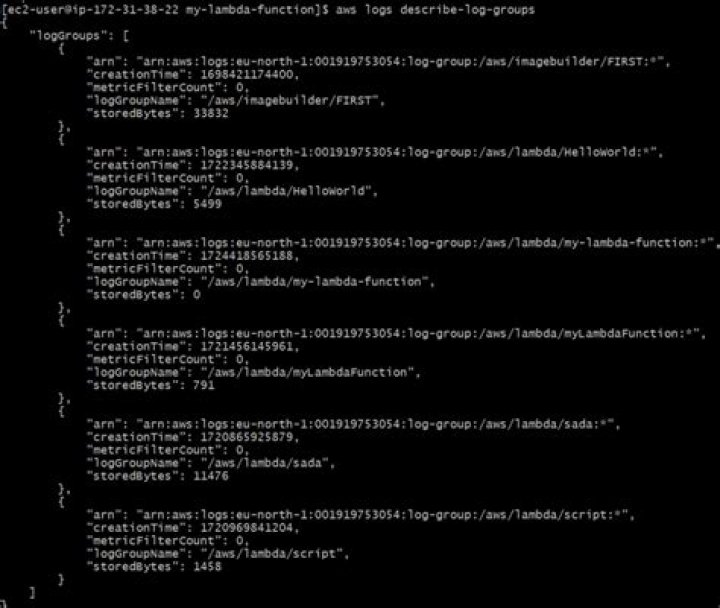
Represents a log group.
logGroupName (string) –
The name of the log group.
creationTime (integer) –
The creation time of the log group, expressed as the number of milliseconds after Jan 1, 1970 00:00:00 UTC.
retentionInDays (integer) –
The number of days to retain the log events in the specified log group. Possible values are: 1, 3, 5, 7, 14, 30, 60, 90, 120, 150, 180, 365, 400, 545, 731, 1096, 1827, 2192, 2557, 2922, 3288, and 3653.
To set a log group so that its log events do not expire, use DeleteRetentionPolicy.
metricFilterCount (integer) –
The number of metric filters.
arn (string) –
The Amazon Resource Name (ARN) of the log group. This version of the ARN includes a trailing :* after the log group name.
Use this version to refer to the ARN in IAM policies when specifying permissions for most API actions. The exception is when specifying permissions for TagResource, UntagResource, and ListTagsForResource. The permissions for those three actions require the ARN version that doesn’t include a trailing :*.
storedBytes (integer) –
The number of bytes stored.
kmsKeyId (string) –
The Amazon Resource Name (ARN) of the KMS key to use when encrypting log data.
dataProtectionStatus (string) –
Displays whether this log group has a protection policy, or whether it had one in the past. For more information, see PutDataProtectionPolicy.
inheritedProperties (list) –
Displays all the properties that this log group has inherited from account-level settings.
(string) –
logGroupClass (string) –
This specifies the log group class for this log group. There are two classes:
The
Standardlog class supports all CloudWatch Logs features.The
Infrequent Accesslog class supports a subset of CloudWatch Logs features and incurs lower costs.
For details about the features supported by each class, see Log classes
logGroupArn (string) –
The Amazon Resource Name (ARN) of the log group. This version of the ARN doesn’t include a trailing :* after the log group name.
Use this version to refer to the ARN in the following situations: