Essex Hemphill b. April 16, 1957 d. November 4, 1995 38 years old
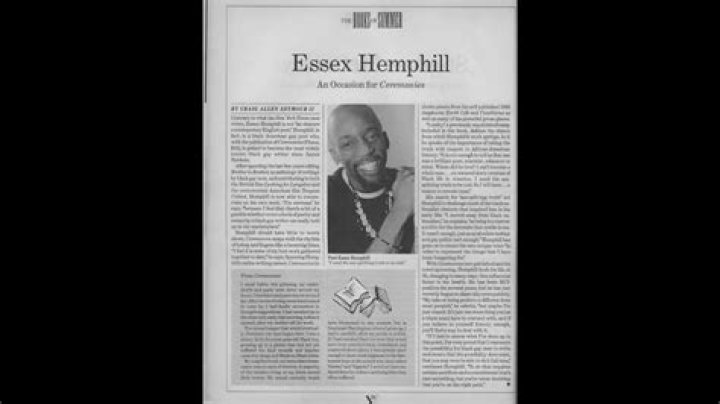
I was brought to Hemphill by reading the work of Joseph Beam, a Philadelphia-based writer and editor. Beam had published Hemphill in In the Life (1986), a book of essays by Black gay writers. After Beam passed away, in 1988, Hemphill moved in with Beam’s mother, Dorothy Beam, who requested that he do so after she looked through her son’s archive. She wanted Hemphill to finish her son’s second collection, Brother to Brother: New Writing by Black Gay Men. Hemphill did so, and the book, which he described as “a community of voices,” was published in 1991; he died in Philadelphia from AIDS-related complications in 1996.
In 1995, Hemphill presented a talk referred to by academics as “On the Shores of Cyberspace,” at Black Nations/Queer Nations?, a groundbreaking conference.
I was counting T-cells on the shores of cyberspace and feeling some despair. … I have miscegenated and mutated, tolerated and assimilated, and yet I remain the same in the eyes of those who would fear and despise me. I stand at the threshold of cyberspace and wonder, Is it possible that I am unwelcome here, too? Will I be allowed to construct a virtual reality that empowers me? Can invisible men see their own reflections? … I’m carrying trauma into cyberspace: violent gestures, a fractured soul, short fuses, dreams of revenge. … My primary public characteristics continue to be defined by dreads of me, myths about me, and plain old homegrown contempt. All of this confusion is accompanying me into cyberspace; every indignity and humiliation, every anger and suspicion.
I responded to these questions by drawing on Hemphill’s body of work, or what exists of him and his work online, and the things of his that friends and loved ones have kept. After the Institute of Contemporary Art in Philadelphia invited me to create a new commissioned work in observance of World AIDS Day, I created an online project, Af-fixing Ceremony: Four Movements for Essex, a four-part work featuring video, sound, and text, named after Charles Nero’s introduction to the second edition reprint of Essex’s pivotal book Ceremonies: Prose and Poetry (1992). In the introduction, “Fixing Ceremonies,” Nero writes:
In an insightful reading of Beloved, the black feminist literary critic Barbara Christian praises [Toni] Morrison for helping us to confront the Middle Passage. Christian asserts that Morrison’s Beloved is a “fixing ceremony” whose purpose “is not merely that of remembrance for the sake of remembrance, but remembrance as the only way to begin the process of healing that psychic wound, which continues to have grave effects on the present.” Christian identifies Beloved as part of a project of communal healing helping us to make peace with those “Sixty Million and more” so that “Those whose names we can no longer specifically call know that we have not forgotten them, that they are our ‘Beloved.’” Christian’s observations about Morrison’s Beloved are relevant to Ceremonies. Much of Ceremonies addresses our queer “beloved” from the life before the AIDS devastation.
In 2015, a young man asked me to refer him to Black gay authors, and I gave him Hemphill’s name, told him to buy the work. He searched on his phone while I spoke to someone else, then he came back to tell me that he couldn’t afford any of Hemphill’s books. They were out of print and cost 200. I was ashamed— I didn’t even own Ceremonies, which I had told the young man to purchase. I had read a library copy when I dropped out of college in 2002.
I began thinking about how I could posthumously engage with Hemphill as a mentor. There’s no formal archive dedicated to Hemphill, only one featuring performance ephemera and unfinished work donated by his former performance partner Wayson Jones, so I learned about him through his friends and peers. The foundation for my approach to Hemphill and his legacy was invocation through ritual. I asked each person the same question: “What did you know of him then? What do you know of him now that he is gone?” Their answers are how I learned to open up.
Fourteen people answered my question. I recorded each conversation with binaural microphones so that I could look into the eyes of the interviewee and be present. The recordings place the listener in my head, with the voices of Hemphill’s friends speaking directly to them. I realized, while listening, that what I was making would not be a sweetheart piece. The words carve a portrait of Hemphill as unflinchingly complex and piercing. He was stunningly brilliant but also difficult. He was difficult in ways that I had never imagined. I was excited by this; I understand why people who knew him and know me say they wish I could have met him. I am difficult in the same way. The remaining two are audio recordings of Dorothy Beam and Sonia Sanchez eulogizing Essex, from Essex’s second memorial service in Philadelphia, recorded by Aishah Shahidah Simmons.
Many of Hemphill’s friends held on to his publications and belongings. E. Ethelbert Miller handed me his self-published chat-book Plums (1982), wrapped in the original gold-foil packaging that so many people had told me about. The filmmaker Michelle Parkerson let me hold a copy of Diamonds Was in the Kitty, a chapbook that Hemphill self-published in 1983, without white gloves. Aishah Shahidah Simmons also found a tape with a recording of one of Hemphill’s last interviews, in 1995, with a Philadelphia radio station, surprising me and herself. He speaks about his friendship with the filmmaker Marlon Riggs, who had passed away the previous year, leaving Hemphill to tour his last film, Black Is … Black Ain’t (1994). I edited Hemphill’s coughing out of the recording—a regret. Sharon Farmer showed me handsome images of Hemphill on tour and performing poetry in the late 1980s, alongside Michelle Parkerson and the poet Wayson Jones. Now a prolific painter, Jones gave the materials related to his and Hemphill’s performances to the New York Public Library’s Schomburg Center for Research in Black Culture; he told me about Hemphill’s precision and how hard he worked.
Slowly, over time, these people helped to give Hemphill a body. Initially, I was extremely motivated and excited by the interviews. But when I heard the playback of the recordings, I was hit so hard with grief that I couldn’t get out of bed for three days. As I listened to each voice, Hemphill’s life became more complex, his body more fully formed, and I was crushed by the weight of his legacy. My face was smashed against white sheets, and I was unable to eat. After listening to his second memorial, organized by friends in Philadelphia, I almost did not finish the work. The eulogy delivered by Joseph Beam’s mother, Dorothy, details the work he did on behalf of her son and demolishes me to this day.
When signing publications and ephemera for those he admired, for friends and supporters, Hemphill wrote: “Take care of your blessings, fiercely.” I take this as a directive. My work is something to take care of. My life is a blessing to take care of, even and especially when it is threatened. I am not dead. I am very much alive, and I will live.
When engaging in a ritual, you must go through the process in order. You must move forward, not backwards. You cannot skip steps. The structure of Af-fixing Ceremony is based on that of a ritual. Before I started, I wanted to seek permission to do this work. But I couldn’t ask Hemphill’s family; they didn’t follow through with his archival placement requests. So I had to ask the spirit. I had never done that for anyone outside of my ancestors and Orisha. That shit was scary.
I asked my Baba to ask Hemphill for permission to do this work and if it would be OK to do so. He said yes. Before interviewing those who survived Hemphill, I cleaned myself for a week. After finishing the work, I cleaned myself again.
Tiona Nekkia McClodden, Af-fixing Ceremony: Four Movements for Essex, 2015, handwritten text. Courtesy of the artist.