SSURGO soils, Schenectady County NY (FGDC metadata)
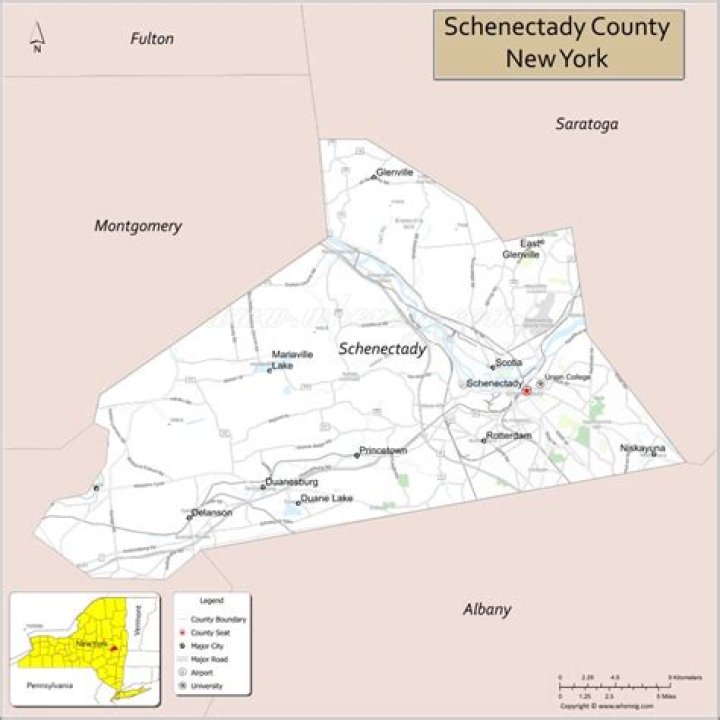
A map unit is a collection of areas defined and named in terms of
their soil components or miscellaneous areas or both. Each map
unit differs in some respect from all others in a survey area and
each map unit has a symbol that uniquely identifies the map unit
on a soil map. Each individual area, point, or line so identified
on the map is a delineation.
Soil Scientists identify small areas of soils or miscellaneous areas
that have properties and behavior significantly different than the
named soils in the surrounding map unit. These minor components
may be indicated as special features. If they have a minimal effect
on use and management, or could not be precisely located, they may
not be indicated on the map.
A map unit has specified kinds of soils or miscellaneous areas
(map unit components), each with a designated range in
proportionate extent. Map units include one or more kinds of soil
or miscellaneous area. Miscellaneous areas are areas that have little
or no recognizable soil.
Specific National Cooperative Soil Survey standards and procedures
were used in the classification of soils, design and name of map
units, and location of special soil features. These standards are
outlined in Agricultural Handbook 18, Soil Survey Manual, 1993,
USDA, NRCS; Agricultural Handbook 436, Soil Taxonomy, 1995,
USDA, NRCS; and all Amendments; Keys to Soil Taxonomy,
(current issue) USDA, NRCS; National Soil Survey
Handbook, title 430-VI,(current issue) USDA, NRCS.
The actual composition and interpretive purity of the map unit
delineations were based on data collected by scientists during
the course of preparing the soil maps. Adherence to National
Cooperative Soil Survey standards and procedures is based on
peer review, quality control, and quality assurance. Quality
control is outlined in the memorandum of understanding for the
soil survey area and in documents that reside with the Natural
Resources Conservation Service state soil scientist. Four kinds
of map units are used in soil surveys: consociations, complexes,
associations, and undifferentiated groups.
Consociations - Consociations are named for the dominant soil.
In a consociation, delineated areas use a single name from the
dominant component in the map unit. Dissimilar components are
minor in extent. The soil component in a consociation may be
identified at any taxonomic level. Soil series is the lowest
taxonomic level. A consociation that is named as a miscellaneous
area is dominantly that kind of area and minor components do not
significantly affect the use of the map unit. The total amount of
dissimilar inclusions of other components in a map unit generally
does not exceed about 15 percent if limiting and 25 percent if
nonlimiting. A single component of a dissimilar limiting inclusion
generally does not exceed 10 percent if very contrasting.
Complexes and associations - Complexes and associations consist
of two or more dissimilar components that occur in a regularly
repeating pattern. The total amount of other dissimilar components
is minor extent. The following arbitrary rule determines whether
complex or association is used in the name. The major components
of an association can be separated at the scale of mapping. In
either case, because the major components are sufficiently different
in morphology or behavior, the map unit cannot be called a
consociation. In each delineation of a complex or an association,
each major component is normally present though their proportions
may vary appreciably from one delineation to another. The total
amount of inclusions in a map unit that are dissimilar to any of
the major components does not exceed 15 percent if limiting and
25 percent if nonlimiting. A single kind of dissimilar limiting
inclusion usually does not exceed 10 percent.
Undifferentiated groups - Undifferentiated groups consist of two
or more components that are not consistently associated
geographically and, therefore, do not always occur together in
the same map delineation. These components are included in the
same named map unit because their use and management are the same
or very similar for common uses. Generally they are grouped together
because some common feature, such as steepness, stoniness, or
flooding, determines their use and management. If two or more
additional map units would serve no useful purpose, they may be
included in the same unit. Each delineation has at least one of the
major components, and some may have all of them. The same principles
regarding the proportion of minor components that apply to
consociations also apply to undifferentiated groups. The same
principles regarding proportion of inclusion apply to
undifferentiated groups as to consociations.
Minimum documentation consists of three complete soil profile
descriptions that are collected for each soil added to the legend,
one additional per 3,000 acres mapped; three 10 observation
transects for each map unit, one additional 10 point transect per
3,000 acres.
A defined standard or level of confidence in the interpretive
purity of the map unit delineations is attained by adjusting the
kind and intensity of field investigations. Field investigations
and data collection are carried out in sufficient detail to name
map units and to identify accurately and consistently areas of
about 4 acres.
Lineage: Source_Information: Source_Citation: Citation_Information:
Originator: U.S Department of Agriculture, Soil Conservation Service
Publication_Date: 1978
Title: Soil Survey of Montgomery and Schenectady Counties, New York
Geospatial_Data_Presentation_Form: atlas
Publication_Information:Publication_Place: Washington, D.C.
Publisher: U.S. Government Printing Office
Source_Scale_Denominator: 15840
Type_of_Source_Media: paper
Source_Time_Period_of_Content: Time_Period_Information: Single_Date/Time:Calendar_Date: 1972
Source_Currentness_Reference: final correlation date
Source_Citation_Abbreviation: SCS1
Source_Contribution: soil attributes and special feature locations
Source_Information: Source_Citation: Citation_Information:Originator: U.S. Department of Agriculture, Natural Resources Conservation Service
Publication_Date: unpublished material
Title: publication annotation overlays
Geospatial_Data_Presentation_Form: map
Source_Scale_Denominator: 15840
Type_of_Source_Media: film
Source_Time_Period_of_Content: Time_Period_Information: Single_Date/Time:Calendar_Date: 1972
Source_Currentness_Reference: final correlation date
Source_Citation_Abbreviation: NRCS1
Source_Contribution: final publication negatives used to develop film positives
Source_Information: Source_Citation: Citation_Information:Originator: U.S. Department of Agriculture, Natural Resources Conservation Service
Publication_Date: unpublished material
Title: ratioed film positives of publication annotated overlays
Geospatial_Data_Presentation_Form: remote sensing image
Source_Scale_Denominator: 12000
Type_of_Source_Media: film
Source_Time_Period_of_Content: Time_Period_Information: Single_Date/Time:Calendar_Date: 1972
Source_Currentness_Reference: final correlation date
Source_Citation_Abbreviation: NRCS2
Source_Contribution: source material for special soil features, soil polygons, and soil attributes
Source_Information: Source_Citation: Citation_Information:Originator: U.S. Department of Agriculture, Natural Resources Conservation Service
Publication_Date: 1998
Title: multiple 3.75 minute orthophotographic quadrangles
Geospatial_Data_Presentation_Form: remote sensing image
Source_Scale_Denominator: 12000
Type_of_Source_Media: stable-base material
Source_Time_Period_of_Content: Time_Period_Information: Range_of_Dates/Times:Beginning_Date: 1994
Ending_Date: 1996
Source_Currentness_Reference: date aerial photography was flown
Source_Citation_Abbreviation: NRCS3
Source_Contribution: base material for compilation and a reference for compilation of cultural features
Source_Information: Source_Citation: Citation_Information:Originator: U.S. Department of Agriculture, Natural Resources Conservation Service
Publication_Date: 2006
Title: Digital Raster Graphic County Mosaic of Schenectady County, New York
Geospatial_Data_Presentation_Form: map
Publication_Information:Publication_Place: Fort Worth, Texas
Publisher: U.S. Department of Agriculture, Natural Resources Conservation Service, National Cartography and Geospatial Center
Source_Scale_Denominator: 24000
Type_of_Source_Media: online
Source_Time_Period_of_Content: Time_Period_Information: Range_of_Dates/Times:Beginning_Date: 1949
Ending_Date: 1978
Source_Currentness_Reference: source material publication date
Source_Citation_Abbreviation: NRCS4
Source_Contribution: source for county boundaries
Source_Information: Source_Citation: Citation_Information:Originator: U.S. Department of Agriculture, Natural Resources Conservation Service
Publication_Date: unpublished material
Title: annotated soil delineation overlays
Geospatial_Data_Presentation_Form: map
Source_Scale_Denominator: 12000
Type_of_Source_Media: stable-base material
Source_Time_Period_of_Content: Time_Period_Information: Range_of_Dates/Times:Beginning_Date: 1994
Ending_Date: 1996
Source_Currentness_Reference: date aerial photography was flown
Source_Citation_Abbreviation: NRCS5
Source_Contribution: scanning and digitizing source
Source_Information: Source_Citation: Citation_Information:Originator: U.S. Department of Agriculture
Publication_Date: 2006
Title: National Soil Information System (NASIS) database for Schenectady County, New York
Geospatial_Data_Presentation_Form: tabular digital data
Publication_Information:Publication_Place: Fort Collins, Colorado
Publisher: U.S. Department of Agriculture, Natural Resources Conservation Service, Information Technology Center
Type_of_Source_Media: online
Source_Time_Period_of_Content: Time_Period_Information: Single_Date/Time:Calendar_Date: 2006
Source_Currentness_Reference: export certification date
Source_Citation_Abbreviation: NRCS6
Source_Contribution: tabular data linked to spatial data
Source_Information: Source_Citation: Citation_Information:Originator: U.S. Department of Agriculture, Natural Resources Conservation Service
Publication_Date: 2006
Title: National Soil Information System (NASIS) data base
Geospatial_Data_Presentation_Form: tabular digital data
Publication_Information:Publication_Place: Fort Collins, Colorado
Publisher: U.S. Department of Agriculture, Natural Resources Conservation Service
Type_of_Source_Media: database
Source_Time_Period_of_Content: Time_Period_Information: Range_of_Dates/Times:Beginning_Date: 2006
Ending_Date: 2006
Source_Currentness_Reference: publication date
Source_Citation_Abbreviation: NASIS
Source_Contribution: attribute (tabular) information
Source_Information: Source_Citation: Citation_Information:Originator: U.S. Department of Agriculture, Natural Resources Conservation Service
Publication_Date: 2006
Title: Soil Survey Geographic (SSURGO) database for Schenectady County, New York
Geospatial_Data_Presentation_Form: vector digital data
Publication_Information:Publication_Place: Fort Worth, Texas
Publisher: U.S. Department of Agriculture, Natural Resources Conservation Service
Source_Scale_Denominator: 12000
Type_of_Source_Media: online
Source_Time_Period_of_Content: Time_Period_Information: Single_Date/Time:Calendar_Date: 2008
Source_Currentness_Reference: publication date
Source_Citation_Abbreviation: NRCS7
Source_Contribution: rearchiving source
Source_Information: Source_Citation: Citation_Information:Originator: U.S. Department of Agriculture, Natural Resources Conservation Service
Publication_Date: 2005 - 2006
Title: Soil Survey Geographic (SSURGO) databases for adjacent surveys
Geospatial_Data_Presentation_Form: vector digital data
Publication_Information:Publication_Place: Fort Collins, Colorado
Publisher: U.S. Department of Agriculture, Natural Resources Conservation Service, Information Technology Center
Other_Citation_Details: These soil surveys are adjacent to (NY093) Schenectady County, New York: NY001 Albany County, New York NY057 Montgomery County, New York NY091 Saratoga County, New York NY095 Schoharie County, New York
Source_Scale_Denominator: 12000, 24000
Type_of_Source_Media: online
Source_Time_Period_of_Content: Time_Period_Information: Range_of_Dates/Times:Beginning_Date: 2005
Ending_Date: 2006
Source_Currentness_Reference: dates of publication
Source_Citation_Abbreviation: NRCS8
Source_Contribution: used to check joins to the adjacent soil surveys
Source_Information: Source_Citation: Citation_Information:Originator: U.S. Department of Agriculture, Natural Resources Conservation Service
Publication_Date: unpublished material
Title: region 12 soils geodatabase
Geospatial_Data_Presentation_Form: file geodatabase
Type_of_Source_Media: vector digital data
Source_Time_Period_of_Content: Time_Period_Information: Range_of_Dates/Times:Beginning_Date: 2006
Ending_Date: 2012
Source_Currentness_Reference: SSURGO publication date
Source_Citation_Abbreviation: NRCS9
Source_Contribution: Source of digital revision
Process_Step:Process_Description: Schenectady County had a soil survey published in 1978, at 1:15840 scale. An evaluation was made of the soil survey in 2001. It was determined that the soil map unit delineations and map unit components were accurate.
Source_Used_Citation_Abbreviation: SCS1
Process_Date: 2001
Process_Step:Process_Description: Ratioed film positives, at 1:12000 scale, were made from the publication annotation overlays. Soil map unit delineations, soil symbols and special soil features were manually compiled from the film positives to stable-base material registered to 3.75 minute orthophotographic quadrangles. Errors from the published soil survey were corrected and map unit boundaries were refined, as needed, to the orthophotographic quadrangles.
Source_Used_Citation_Abbreviation: NRCS1, NRCS2, NRCS3, NRCS5
Process_Date: 2005
Process_Step:Process_Description: The National Soil Information System data base was developed by Natural Resources Conservation Service soil scientists according to national standards.
Source_Used_Citation_Abbreviation: SCS1, NRCS6
Process_Date: 2006
Process_Step:Process_Description: The compiled soil and feature overlays were mailed to the Wisconsin Digitizing Unit in Madison, Wisconsin. The 3.75 minute soil map unit delineation and label overlays were raster scanned by Midwest Graphics, Kenosha, Wisconsin at 250 dpi on an Intergraph Anatech scanner in tiff uncompressed format. The data were sent to the Wisconsin Digitizing Unit in Madison, Wisconsin. Four control points corresponding to the four corners on the 3.75 minute quadrangles were used for registration during data collection. The tiff files were imported into ArcGIS 9.1 ArcMap. The tiff files were georeferenced in ArcMap. Using the raster cleanup tools, the tiff files were cleaned, edge-matched and vectorized to a polygon feature class. Using the label overlay tiff files as a back drop, the soil polygons were attributed and line and point features classes were digitized and labeled. A digital county boundary was added and soil lines were edgematched to the surrounding counties. Using topology rules, errors were identified and corrected. The data were then exported to polygon, line, and point coverages using ArcCatalog. Next, the data were then projected to Geographic coordinates in decimal degrees and run through the 20040524 ReCert AMLs provided by NCGC and uploaded to the Soil Data Warehouse for archival and distribution.
Source_Used_Citation_Abbreviation: NRCS4, NRCS5
Process_Date: 2006
Process_Step:Process_Description: The Natural Resources Conservation Service State Soil Scientist or delegate, upon completion of data quality verification, determined that the tabular data should be released for official use. A selected set of map units and components in the soil survey legend was copied to a staging database, and rating values for selected interpretations were generated. The list of selected interpretations is stored in the database table named sainterp.
Source_Used_Citation_Abbreviation: NASIS
Process_Date: 20060821
Process_Step:Process_Description: The Natural Resources Conservation Service State Soil Scientist or delegate verified that the labels on the digitized soil map units link to map units in the tabular database, and certified the joined data sets for release to the Soil Data Warehouse. A system assigned version number and date stamp were added and the data were copied to the data warehouse. The tabular data for the map units and components were extracted from the data warehouse and reformatted into the soil data delivery data model, then stored in the Soil Data Mart. The spatial data were copied to the Soil Data Mart without change.
Source_Used_Citation_Abbreviation: NASIS
Process_Date: 20060821
Process_Step:Process_Description: The Natural Resources Conservation Service State Soil Scientist or delegate, upon completion of data quality verification, determined that the tabular data should be released for official use. A selected set of map units and components in the soil survey legend was copied to a staging database, and rating values for selected interpretations were generated. The list of selected interpretations is stored in the database table named sainterp.
Source_Used_Citation_Abbreviation: NASIS
Process_Date: 20061211
Process_Step:Process_Description: Soil scientists entered/edited data in NASIS for geomorphic description and selected chemical and physical properties. The Natural Resources Conservation Service State Soil Scientist or delegate verified that the labels on the digitized soil map units link to map units in the tabular database, and certified the joined data sets for release to the Soil Data Warehouse. A system assigned version number and date stamp were added and the data were copied to the data warehouse. The tabular data for the map units and components were extracted from the data warehouse and reformatted into the soil data delivery data model, then stored in the Soil Data Mart. The spatial data were copied to the Soil Data Mart without change.
Source_Used_Citation_Abbreviation: NASIS
Process_Date: 20061211
Process_Step:Process_Description: The Natural Resources Conservation Service State Soil Scientist or delegate, upon completion of data quality verification, determined that the tabular data should be released for official use. A selected set of map units and components in the soil survey legend was copied to a staging database, and rating values for selected interpretations were generated. The list of selected interpretations is stored in the database table named sainterp.
Source_Used_Citation_Abbreviation: NASIS
Process_Date: 20100204
Process_Step:Process_Description: Soil scientists reviewed and edited data for hydric rating and hydric criteria. Interpretations for storm water management were added to the set of interpretations. The Natural Resources Conservation Service State Soil Scientist or delegate verified that the labels on the digitized soil map units link to map units in the tabular database, and certified the joined data sets for release to the Soil Data Warehouse. A system assigned version number and date stamp were added and the data were copied to the data warehouse. The tabular data for the map units and components were extracted from the data warehouse and reformatted into the soil data delivery data model, then stored in the Soil Data Mart. The spatial data were copied to the Soil Data Mart without change.
Source_Used_Citation_Abbreviation: NASIS
Process_Date: 20100205
Process_Step:Process_Description: The Michigan Digitizing Unit (MIDU) staff downloaded the SSURGO data for Schenectady County, New York and the adjacent surveys from the Soil Data Warehouse (SDW). The MIDU staff checked the spatial data with the ARCGIS Version 9.2 software. To remove excess vertices, the soil boundaries were generalized at a 0.5 meter tolerance. The boundaries of this soil survey were adjusted to match the adjacent soil surveys at the 0.1 meter tolerance. After the soil survey was edited, the area, line and point feature classes were converted to ARC/INFO coverages and exported as e00 files. The seamless coverages were checked using the July 2009 SSURGO Evaluation AML programs. The labels in the spatial data matched the symbols in the mapunit table from NASIS. Upon successful completion of the SSURGO Evaluation, the county coverages, feature file and the metadata were electronically transferred to the NRCS Staging Server to be joined with the tabular data.
Source_Used_Citation_Abbreviation: NASIS, NRCS7, NRCS8
Process_Date: 2011
Process_Step:Process_Description: The Natural Resources Conservation Service State Soil Scientist or delegate verified that the labels on the digitized soil map units link to map units in the tabular database, and certified the joined data sets for release to the Soil Data Warehouse. A system assigned version number and date stamp were added and the data were copied to the data warehouse. The tabular data for the map units and components were extracted from the data warehouse and reformatted into the soil data delivery data model, then stored in the Soil Data Mart. The spatial data were copied to the Soil Data Mart without change.
Source_Used_Citation_Abbreviation: NASIS
Process_Date: 20110315
Process_Step:Process_Description: The Natural Resources Conservation Service State Soil Scientist or delegate, upon completion of data quality verification, determined that the tabular data should be released for official use. A selected set of map units and components in the soil survey legend was copied to a staging database, and rating values for selected interpretations were generated. The list of selected interpretations is stored in the database table named sainterp.
Source_Used_Citation_Abbreviation: NASIS
Process_Date: 20111208
Process_Step:Process_Description: Hydric ratings for minor soil components were included in the data set. Hydrologic Soil Group data was updated to current criteria. The Natural Resources Conservation Service State Soil Scientist or delegate verified that the labels on the digitized soil map units link to map units in the tabular database, and certified the joined data sets for release to the Soil Data Warehouse. A system assigned version number and date stamp were added and the data were copied to the data warehouse. The tabular data for the map units and components were extracted from the data warehouse and reformatted into the soil data delivery data model, then stored in the Soil Data Mart. The spatial data were copied to the Soil Data Mart without change.
Source_Used_Citation_Abbreviation: NASIS
Process_Date: 20111208
Process_Step:Process_Description: The spatial data for Schenectady County, New York soil survey area was downloaded from the Soil Data Mart on October 15, 2012. The individual shapefiles were appended into a geodatabase for region 12. The data were processed in ARCGIS 10.1 using a topology object with a 0.1 meter cluster tolerance for the purpose of eliminating gaps and overlaps within the region 12 soils geodatabase. Individual soil survey area data were exported as shapefiles from the regional geodatabase. A datum transformation from NAD83 to WGS84 using the NAD_1983_To_WGS_1984_1 datum transformation method was applied to the data. The data were checked with the SSURGO Evaluation scripts provided by U.S. Department of Agriculture, Natural Resources Conservation Service. The shapefiles were then uploaded to the soil data warehouse for archival and distribution.
Source_Used_Citation_Abbreviation: NRCS9
Process_Date: 2013
Process_Step:Process_Description: The Natural Resources Conservation Service State Soil Scientist or delegate, upon completion of data quality verification, determined that the tabular data should be released for official use. A selected set of map units and components in the soil survey legend was copied to a staging database, and rating values for selected interpretations were generated. The list of selected interpretations is stored in the database table named sainterp.
Source_Used_Citation_Abbreviation: NASIS
Process_Date: 20131124
Process_Step:Process_Description: The Natural Resources Conservation Service State Soil Scientist or delegate verified that the labels on the digitized soil map units link to map units in the tabular database, and certified the joined data sets for release to the Soil Data Warehouse. A system assigned version number and date stamp were added and the data were copied to the data warehouse. The tabular data for the map units and components were extracted from the data warehouse and reformatted into the soil data delivery data model, then stored in the Soil Data Mart. The spatial data were copied to the Soil Data Mart without change.
Source_Used_Citation_Abbreviation: NASIS
Process_Date: 20131124
Process_Step:Process_Description: The Natural Resources Conservation Service State Soil Scientist or delegate, upon completion of data quality verification, determined that the tabular data should be released for official use. A selected set of map units and components in the soil survey legend was copied to a staging database, and rating values for selected interpretations were generated. The list of selected interpretations is stored in the database table named sainterp.
Source_Used_Citation_Abbreviation: NASIS
Process_Date: 20140916
Process_Step:Process_Description: Soil interpretation factors K, T, WEG, WEI, concrete corrosion potential, and steel corrosion potential were calculated based on national standard parameters. The Natural Resources Conservation Service State Soil Scientist or delegate verified that the labels on the digitized soil map units link to map units in the tabular database, and certified the joined data sets for release to the Soil Data Warehouse. A system assigned version number and date stamp were added and the data were copied to the data warehouse. The tabular data for the map units and components were extracted from the data warehouse and reformatted into the soil data delivery data model, then stored in the Soil Data Mart. The spatial data were copied to the Soil Data Mart without change.
Source_Used_Citation_Abbreviation: NASIS
Process_Date: 20140916
Process_Step:Process_Description: The Natural Resources Conservation Service State Soil Scientist or delegate, upon completion of data quality verification, determined that the tabular data should be released for official use. A selected set of map units and components in the soil survey legend was copied to a staging database, and rating values for selected interpretations were generated. The list of selected interpretations is stored in the database table named sainterp.
Source_Used_Citation_Abbreviation: NASIS
Process_Date: 20150924
Process_Step:Process_Description: The Natural Resources Conservation Service State Soil Scientist or delegate verified that the labels on the digitized soil map units link to map units in the tabular database, and certified the joined data sets for release to the Soil Data Warehouse. A system assigned version number and date stamp were added and the data were copied to the data warehouse. The tabular data for the map units and components were extracted from the data warehouse and reformatted into the soil data delivery data model, then stored in the Soil Data Mart. The spatial data were copied to the Soil Data Mart without change.
Source_Used_Citation_Abbreviation: NASIS
Process_Date: 20150924
Process_Step:Process_Description: The Natural Resources Conservation Service State Soil Scientist or delegate, upon completion of data quality verification, determined that the tabular data should be released for official use. A selected set of map units and components in the soil survey legend was copied to a staging database, and rating values for selected interpretations were generated. The list of selected interpretations is stored in the database table named sainterp.
Source_Used_Citation_Abbreviation: NASIS
Process_Date: 20160924
Process_Step:Process_Description: The Natural Resources Conservation Service State Soil Scientist or delegate verified that the labels on the digitized soil map units link to map units in the tabular database, and certified the joined data sets for release to the Soil Data Warehouse. A system assigned version number and date stamp were added and the data were copied to the data warehouse. The tabular data for the map units and components were extracted from the data warehouse and reformatted into the soil data delivery data model, then stored in the Soil Data Mart. The spatial data were copied to the Soil Data Mart without change.
Source_Used_Citation_Abbreviation: NASIS
Process_Date: 20160924