Types of filament
14.5.1 Types of filament
Note that while there any many different and interesting types offilament, different types of filament have different requirements forprinting: know your filament’s characteristics.
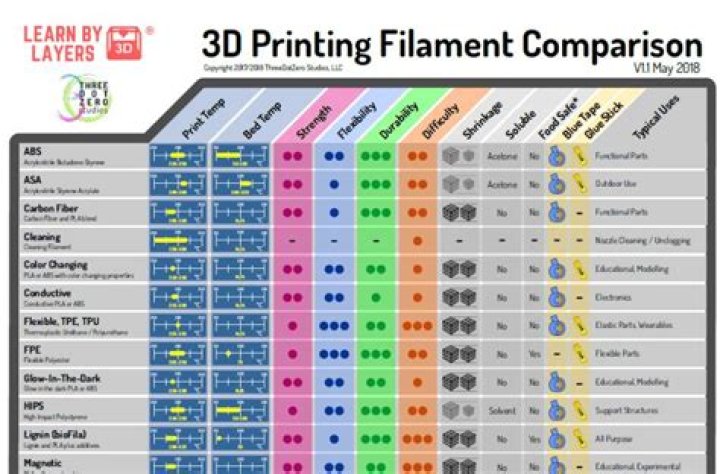
Just a sample...
For instance, glow-in-the-dark PLA filament is fun for students.But be aware that it is typically: (a) fairly abrasive on the extrudernozzle – be prepared to replace your extruder nozzle if you performmuch glow-in-the-dark printing, (b) more expensive than regularPLA, and (c) green and blue glow effects are generally moresatisfactory than other colors. Some users recommend that best gloweffects result from objects that are fairly hollow but with thickerwalls, so consider slicing objects using no (or very little) infill while adding a few more shells than usual; when printing via the PolarCloud, see settings under “PRINT SETTINGS”, “ADVANCED”, “Fill”and “Quality”.
Similarly, color-changing PLA filament – changing color inresponse to temperature or, for some brands, in response to UVlight – can be fun for students. It also tends to be more expensivethan regular PLA, but unlike the glow-in-the-dark PLA, does nottend to be especially abrasive.
Wood filament (PLA infused with wood dust/wood fibers) resultsin objects with the look and feel of wood. A number of differentbrands, incorporating different types of woods, are available.Note that it’s moderately difficult to work with (as opposedto plain PLA which is relatively easy): it tends to be morefinicky about print temperature (which typically needs to be abit higher than that for Polar 3D PLA), is subject to someshrinking during printing, and may not adhere as easily as plainPLA.
Conductive PLA is PLA infused with conductive carbon. Itallows printing low-voltage electronics. It tends to need to print at aslightly higher temperature than plain PLA, and while it isconsidered fairly easy to print, and is not reported to be particularlyabrasive on the extruder nozzle, it is a little harder to get it toadhere (even to itself); also, it tends to be expensive compared to regular PLA.
Carbon Fiber PLA is PLA mixed with small, chopped carbonfibers. It results in strong objects, much stronger than regular PLA,but is extremely abrasive on the extruder nozzle; expect to havetoreplace your extruder nozzle after printing only 550g (half a regularspool) of carbon fiber PLA.
Metal PLA is PLA combined with fine metallic power, such asbronze powder, brass powder, copper powder, aluminum powder, orsteel powder. Objects 3D printed using metal PLA filament will lookand feel as if they were made of metal, can be polished like metal,and will be denser (heavier) than regular plastic objects, heftingmore like metal. However, metal PLA is quite abrasive on theextruder nozzle, especially when the incorporated metal is a hardermetal than the brass of the extruder nozzle. Metal PLA filament isconsidered quite a difficult filament to get printing well, so be readyfor a challenge!
Soft PLA is PLA mixed with a chemical to make it softer andmore flexible, to give a rubbery effect, in contrast to normal PLAwhich yields fairly brittle results. Soft PLA can be quite useful forsome types of objects, but note that it can be more of a challenge toprint than regular PLA. Typical recommendations are: pay extra attention to first layer adhesion, print a little slower than for regularPLA (perhaps 20mm/s), print at a slightly higher temperature thanregular PLA, and use very little (perhaps zero) retraction. Becauseof the pitfalls of attempting much retraction when using softPLA, instead consider using the “Enable Combing” option(under “PRINT SETTINGS”, “ADVANCED”, “Retraction”), ifyour object’s design is suitable (i.e., no flat top surfaces, andmostly connected layer contours). (Note: While it is quitedifficult to successfully use soft PLA on a 3D printer thatuses a “bowden tube” to feed filament, note that none of thePolar3D, FlashForge, or DREMEL 3D45 printers have such a“bowden tube” design, so printing soft PLA is feasible onthem.)
ABS filament is second only to PLA filament in terms ofpopularity for general 3D printer use. However, it is not usuallyrecommended for use in the classroom, due to the intense fumes itgenerates during printing which can be dangerous for thosewith breathing difficulties; when printing ABS, the 3D printermust be placed in a well-ventilated area, and you must avoidbreathing in the fumes when it is in use. Also, ABS shrinks whilecooling, so it is very prone to curling, and pulling up from thebuild plate. Due to ABS’s thermal issues, it prints best onprinters that incorporate both a heated build plate (to lessen thetemperature differential between the bottom and top of the objectwhile printing) and an enclosure around the print area (to lessen the effect of cooling drafts); neither feature is part of thePolar3D printer. However, by extra attention to issues ofadhesion and thermal insulation, it is possible to print ABSon a Polar3D printer: use of Elmer’s Xtreme glue stick onthe build plate (to glue down the object even as it attemptsto cool and shrink) and adding a tall skirt around the mainobject (to shield it from drafts) are techniques that can beused.
Nylon filament is not as popular as PLA or ABS, and is ofmoderate difficulty to print, but if you have a 3D printer that canhandle it, it has some interesting features. Nylon filament producesvery strong and durable, yet somewhat flexible, results, so it is verysuitable for making tools or moving mechanical parts such ashinges or gears. As nylon filament absorbs water, it can bedyed (using fabric dyes); you may dye nylon filament beforemaking an object, or dye a nylon object after it has beenprinted. The water-absorbing property of nylon filament doesmean, however, that nylon filament typically needs to be storedspecially to keep it dry and the filament may have a short shelflife; it is one of the more hydroscopic filaments (will absorbmoisture from the air). Indeed, nylon filament may even needto be specially dried out before printing – in particular, ifyou’ve dyed it – as nylon filament that has been allowed toabsorb moisture and still retains that moisture will not print assuccessfully. With nylon filament, as with ABS, you will need topay particular attention to ensuring good adhesion to theprint bed. Nylon filament must be printed at a relativelyhigh temperature – typically about 260° C, and as it is quitesusceptible to shrinking while printing, prints much better on a printer with a heated print chamber (and a heated printbed, while not as necessary, is also helpful). Note that thehigh print temperature means that nylon filament must beprinted using an all-metal extruder – and the extruder mustnot be coated with any material such as PEEK (polyetherether ketone) or PTFE (polytetrafluoroethylene, e.g., Teflon)that starts breaking down (with noxious fumes) at such printtemperatures! Many 3D printers (including Polar3D printers) comestandard with extruders that are not suitable for printingnylon; always check the specifications of a printer’s extruder orcheck with the printer manufacturer before attempting toprint nylon filament. However, the DREMEL 3D45 printercomes with an all-metal extruder, and the Polar Cloud providesslicing profiles for printing nylon filament on DREMEL 3D45printers.
PET (PolyEthylene Terephthalate) filament and PETG (a blendof PET with glycerol) filament are very versatile, reasonably easy towork with, newer filaments, with PETG being a version betteradapted for 3D printing. For ease of printing, PETG is intermediatebetween PLA and ABS. However, PETG does tend to be moreexpensive than regular PLA. Note general recommendations to printPET and PETG a little more slowly than some other filaments;when printing through the Polar Cloud, see the “PRINT SETTINGS:BASIC” setting for “Print Speed”. A printer with a heatedbed is helpful (though not absolutely necessary) for printingwith PET or PETG. PETG is hydroscopic (it will absorbmoisture from the air), so it must be stored to prevent absorbing moisture; even a day sitting out in high humidity may result innoticeably poorer quality prints (with stringing, and roughsurfaces).
There are many more types of filament, with new kindscontinuing to come out. While some types produce fumes requiringventilation (thus being less suitable for the classroom), or need orbenefit from a heated build plate (not a feature of the Polar3Dprinter), or are distinctly more challenging to use than regular PLA,and exotic types tend to be more expensive, still other types may beof interest to you.
For some further discussion of these and additional filamenttypes, see:
Polar 3D youtube video: WWBD – The Different Types ofFilaments